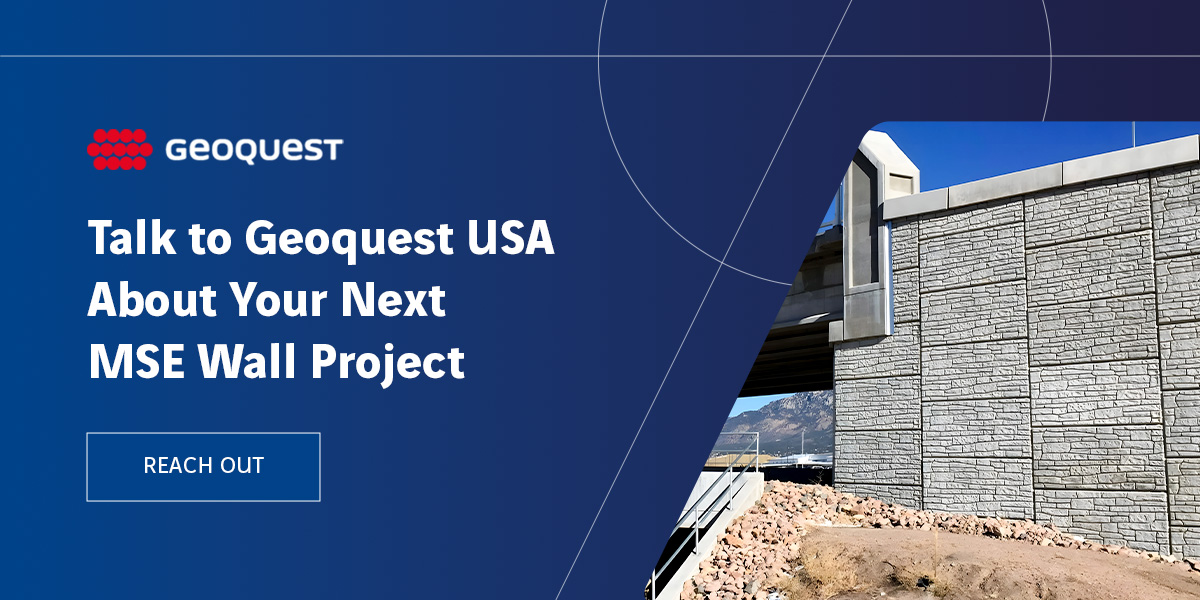

A mechanically stabilized earth (MSE) wall is an earth retaining structure constructed with backfill, soil reinforcements and facing elements. These components work together to resist earth pressure and bear heavy loads without the need for large amounts of concrete.
With its modular design, MSE walls can be constructed efficiently, which often makes them a cost-effective choice on projects with tight construction schedules. These structures are commonly used in large infrastructure projects across the country, retaining soil along highway embankments, bridge abutments, railways and industrial sites.
The Three Core Components of MSE Walls
The following three components function as a single system in an MSE retaining wall:
1. Facing Elements
Facing elements are the visible, vertical face of the wall, commonly made of wire mesh or precast concrete panels. Facing is relatively thin and gives the wall a finished look. The type of facing to choose for a project depends on its aesthetic and performance requirements.
An MSE wall’s facing does more than add an architectural touch. Facing elements prevent localized erosion and keep soil from spilling out. Additionally, facing provides the surface for connectors to attach to the soil reinforcements. The connection method depends on the facing system and reinforcement type used, which an engineer determines based on the specific wall design.
2. Soil Reinforcements
Soil reinforcements are the structural elements embedded in the backfill. Their job is to resist tension, the type of force soil alone can’t hold on its own. MSE wall reinforcements connect to the facing and extend back into the backfill, typically for a distance determined by the wall’s height and the loads it needs to carry.
Soil reinforcements come in a few different forms, including steel reinforcement strips, bar mats and geogrid. Working with the backfill, these reinforcements are what allow the soil mass to function as a structural system capable of carrying significant static and dynamic loads.
3. Backfill
Backfill is the material that’s placed and compacted in layers around the reinforcements, ranging from natural soils like sand to manufactured options such as low-density cellular concrete. The backfill in an MSE wall must have enough shear strength to hold its shape under load, drain well enough to prevent water buildup, and resist compressing or settling over time. When backfill meets those criteria, the reinforcement can perform properly over the structure’s full design life.
How Reinforcement and Backfill Work Together
The strength of an MSE wall comes down to how backfill and reinforcement interact, a relationship called soil-reinforcement interaction. When backfill is compacted around the reinforcement, it presses tightly against the reinforcement’s surface. That tight contact allows the soil to grip the reinforcement once the wall is under load through friction and passive resistance.
Flat reinforcement, like steel strips, grips mainly through friction along its surface. Grid-type reinforcement relies primarily on passive resistance, with some friction also occurring, as compacted soil pushes against the bars running perpendicular to its length.
As earth pressure builds behind the wall, friction or passive resistance anchors the reinforcement in place. The reinforcement then carries that load along its length and into the surrounding soil mass, spreading the force across a wide area rather than concentrating it at the facing.
Verifying MSE Wall Stability
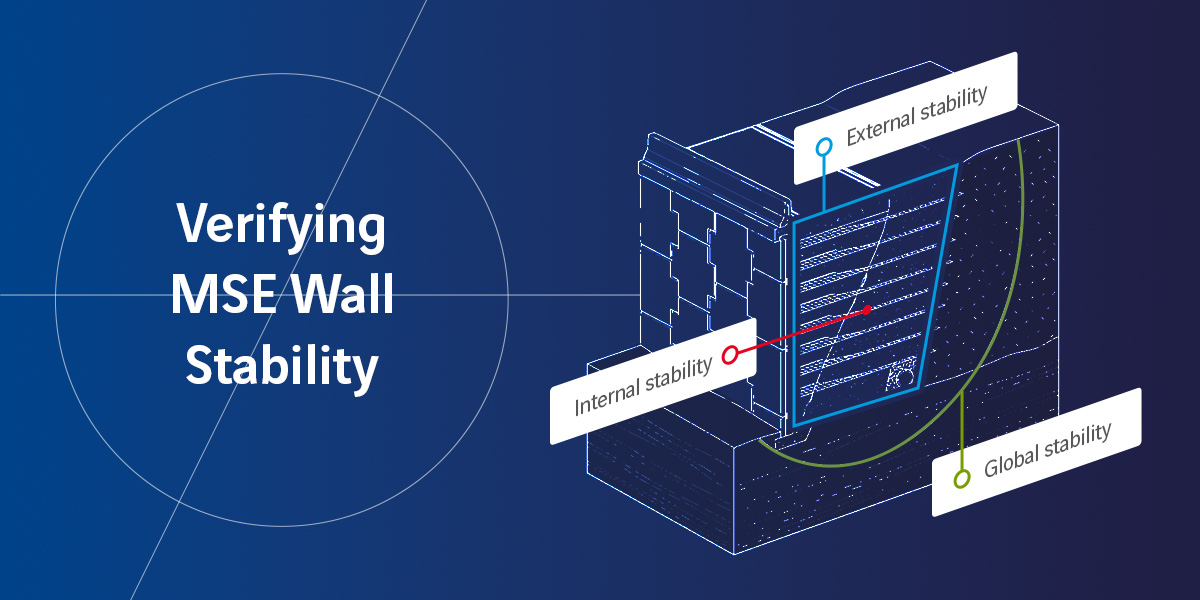
The soil-reinforcement interaction has to satisfy three separate design checks, each looking at a different part of the system:
- Internal stability confirms that individual reinforcement elements have enough pullout capacity to stay anchored in the backfill without breaking under load.
- External stability evaluates the entire reinforced soil mass as a single unit, the way a conventional gravity wall would be assessed, for sliding, bearing capacity and whether the load stays centered.
- Global stability looks beyond the reinforced zone entirely, checking the slope behind and beneath the wall, which matters most on sites with weak or compressible foundation soils.
Engineers calculate internal, external and global stability using the AASHTO LRFD design framework, which accounts for how loads and resistances vary across different soil conditions and wall geometries.
Types of Retaining Wall Reinforcement
Selecting MSE wall reinforcement requires evaluating the site’s soil and environmental conditions, particularly corrosion risk. Engineers must also consider how much the wall can shift within design tolerances. Based on these factors, engineers can choose between rigid inextensible reinforcement and flexible extensible reinforcement, weighing how each option is expected to perform over the structure’s design life.
Inextensible Reinforcement
Inextensible reinforcement is a rigid material that resists stretching under tension. It includes steel reinforcement strips and bar mats.
Strips and bar mats both typically consist of hot-dip galvanized steel and connect to the facing through bolted or clevis loop connections. Inextensible reinforcement offers strong pullout capacity and dependable corrosion resistance when paired with properly selected backfill.
Extensible Reinforcement
Extensible reinforcement is a flexible material classified by its stress-strain behavior and ability to deform with the reinforced soil mass under load. It includes geogrid reinforcement, a grid-shaped polymer material, along with other geosynthetic materials.
This reinforcement connects to the facing through sleeve or wrapped connections. It offers strong pullout capacity and natural resistance to corrosion, making it well-suited for soils with higher salt or chemical content.
Types of Retaining Wall Backfill
When specifying backfill, engineers evaluate several factors like shear strength, drainage, electrochemical properties and compressibility. These characteristics determine how well the backfill will grip the reinforcement, drain water, resist corrosion and hold its shape over time within specific site conditions. Types of backfill include:
- Select granular fill: The standard option in most applications, since it drains well and grips reinforcement effectively. Examples include sand and crushed stone.
- Lightweight aggregates: Used when foundation soils can’t support standard granular backfill without sinking or settling more than the design allows. Examples include expanded clay and shale.
- Foamed glass aggregate: An ultra-lightweight material used to minimize settlement risk on especially weak or compressible soils.
- Low-density cellular concrete: A flowable, cement-based mixture suited to tight or unusual wall geometries where standard fill placement is difficult.
Talk to Geoquest USA About Your Next MSE Wall Project
Facing, reinforcement and backfill must work together in a unified system. Getting each component right is what makes an MSE retaining wall capable of handling heavy loads reliably over the long haul.
If your project calls for an MSE wall, Geoquest USA designs the facing and reinforcement system to your specifications and site conditions. We’ve engineered and supplied MSE walls and related structures for infrastructure projects in the United States since 1971, delivering more than 45,000 structures to clients across dozens of states.
Browse our projects for examples of completed work, or reach out to us to talk through your site conditions and project requirements.