

As highway agencies adopt higher safety standards to accommodate increased traffic volume, the performance of roadside barriers supported on Mechanically Stabilized Earth (MSE) walls has been an area of focus. Full scale crash testing for MASH test levels TL-3 through TL-5 and extensive dynamic finite element modeling (LS-DYNA) has confirmed excellent performance of properly designed precast concrete traffic barriers with cast-in-place moment slabs supported on MSE walls. This outcome is not new. It is the product of more than four decades of innovation, testing, and refinement led by Terre Armée Internationale and Geoquest USA, Inc., formerly The Reinforced Earth Company (RECo) whose pioneering work began in the 1980’s, well before LRFD and MASH criteria were implemented in the USA.
First Crash Test of Traffic Barrier on MSE Wall (1982)
The first full-scale crash test of a traffic barrier constructed on an MSE wall was completed in 1982 by Terre Armée Internationale, Geoquest’s international research organization. In this test, an intercity commuter bus, loaded with steel billet, weighing 26,600 lbs. impacted a 32-in-tall New Jersey shaped concrete barrier traveling at 44.2 mph and impacting the barrier at an angle of 20 degrees. Despite the vehicle speed being only 44.2 mph, the resulting impact force was up to 25% greater than that of a MASH TL-4 impact due to the greater vehicle weight and more direct impact angle than that used in a MASH TL-4 crash test. The impact force was distributed to a 4.1 ft wide continuous cast-in-place moment slab cast in 29.5 ft lengths along the top of a 10-ft-high Reinforced Earth® wall. The New Jersey shaped parapet was slip formed in place on top of 5 ft long precast concrete half connector sections with only two longitudinal #4 rebars along its length. The parapet was essentially unreinforced concrete (see Figure 1).
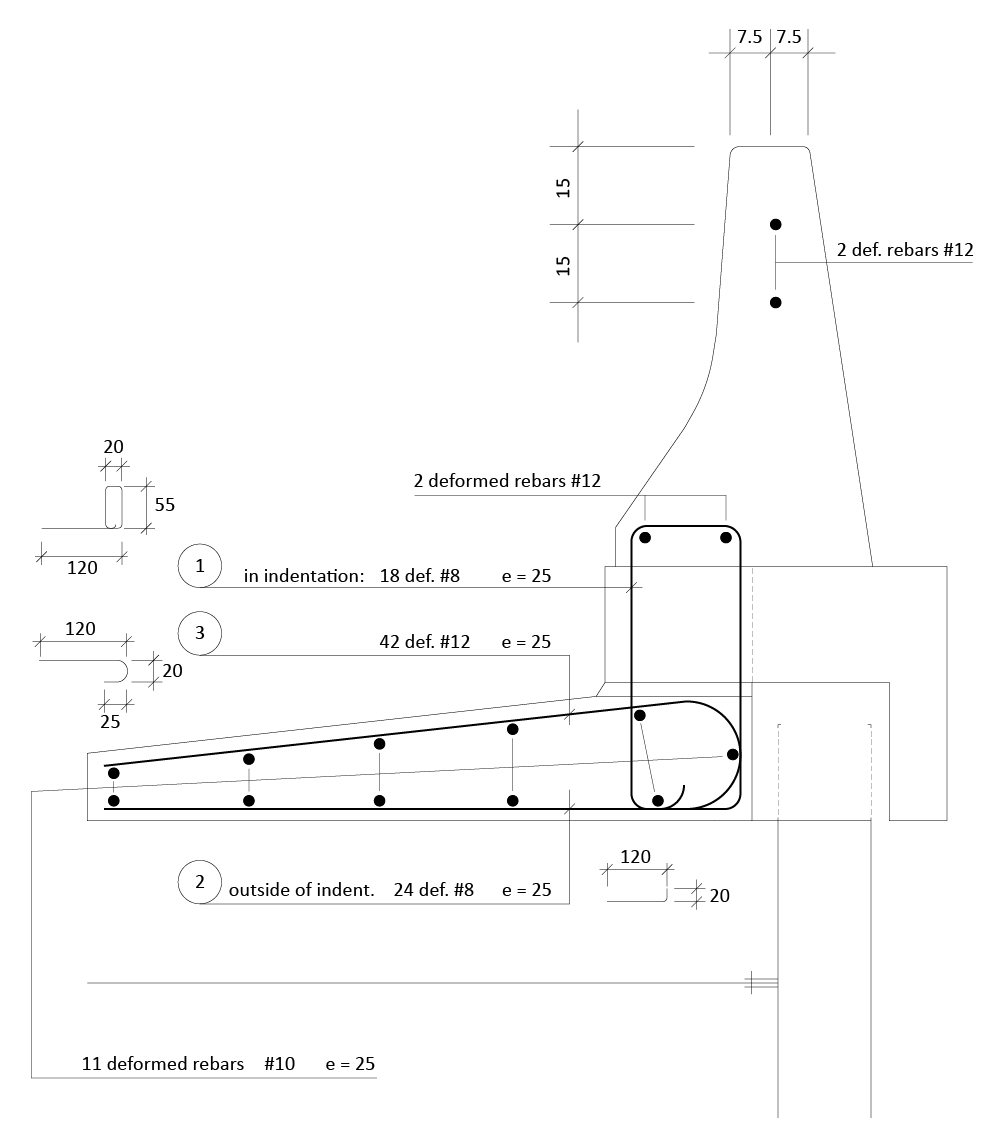
Figure 1: GBA safety structure complete with slab (metric units)
The slip formed parapet sustained damage consisting of a classical V-shaped break over a length of 7.2 ft. with a maximum trough of 1.6 ft. The CIP moment slab and MSE wall panels experienced an instantaneous dynamic displacement of 0.19-inch resulting in only 0.06-inch permanent displacement. The moment slab and parapet alignment after the test was acceptable to remain in service following localized repair of impact damage to the unreinforced parapet section. The MSE wall panels were insulated from the impact shock by the space provided between the precast half connector coping and panel, and the measured total load in the steel soil reinforcing strips (6.5 Kips) was well within the allowable load for the strips (7.2 Kips). This early test confirmed a principle that remains fundamental today: the steel reinforced soil behaves as a composite material capable of absorbing and distributing impact loads efficiently.
Patent for Precast Traffic Barriers on MSE Structures (1985)
In 1985, Geoquest (then operating as The Reinforced Earth Company, or RECo) patented a precast concrete traffic barrier designed to be constructed atop Reinforced Earth® structures. This system formalized the barrier-moment slab concept that remains in use today. The key features of the patent are:
- A precast barrier with a formed recess in the bottom to prevent the barrier from sliding off the wall during installation until the moment slab is cast-in-place.
- Use of level up concrete on the top MSE wall panels to achieve the precise top elevation of the barrier and roadway gutter line and compensate for any wall settlement that occurred prior to setting the precast barrier sections.
- A precast barrier with a formed recess that hides the level up concrete and stepped top of panels from view.
Fundamentals of the precast barrier system include:
- A moment slab that provides overturning and sliding resistance to impact loads.
- Transfer of impact loads to the MSE soil reinforcements with limited permanent displacement of the traffic barrier.
- A precast concrete barrier that can sustain multiple impact events without major repair.
The patented system enabled repeatable designs that combined constructability with proven performance and limited displacement of the precast barrier and moment slab when subjected to impact events.
Implementation of LRFD and MASH
Design standards evolved in the USA with the implementation of Load and Resistance Factor Design (LRFD) and incorporation of the AASHTO Manual for Assessing Safety Hardware (MASH). When compared with the earlier NCHRP Report 350 crash test criteria (1993) MASH marginally increased the weight of the test vehicle for TL-3 and marginally increased both the weight and speed of the test vehicle for TL-4. The test vehicle weight and speed for TL-5 was unchanged. The angle of incidence for all three tests remained unchanged. The MASH recommendations are as follows:
- TL-3: 5,000 lb. pickup truck with an impact speed of 62 mph at 25-degree angle
- TL-4: 22,000 lb. single-axle truck with an impact speed of 56 mph at 15-degree angle
- TL-5: 79,300 lb. tractor-trailer with an impact speed of 50 mph at 15-degree angle
The MASH performance criteria are mostly focused on containing and safely redirecting the vehicle along the barrier with limited consideration for the integrity of the barrier itself. Hence the need for NCHRP to place limits on displacement so that the barrier can continue to function with minimal maintenance for future impact events.
TL-3 Bogie and Full-Scale Crash Test
NCHRP Report 663 presents the results of project NCHRP 22-20 Design of Roadside Barrier Systems Placed on MSE Retaining Walls. The project included a summary of the state of the practice for design of MSE walls with traffic barrier, a full-scale static load test on a wall mounted precast barrier, multiple full-scale crash tests on a precast barrier with a steel frame (Bogie Vehicle) at controlled speeds impacting the barrier head on at 90-degrees, static and dynamic soil reinforcement pullout tests, dynamic finite element modeling (LS-DYNA) to simulate dynamic impact behavior, and a full-scale MASH TL-3 crash test with a 4951 lb. pickup truck traveling at 63.2 mph impacting the barrier at 25.6 degrees.
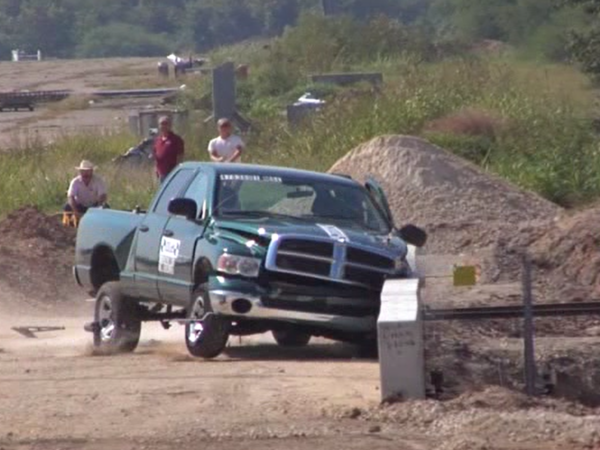
TL-3 Crash Test
Conclusions of this research confirmed that the 10-kip pseudo static load used for decades for stability analysis of MSE wall mounted traffic barriers is an appropriate number to continue using in calculations for TL-3 impact conditions. The loads recommended for checking against MSE soil reinforcement rupture and pullout were nominally increased by 8% and 15% respectively over the loads previously used for decades based on the early crash test of 1982. This nominal increase did not change soil reinforcement densities used in practice.
TL-4 and TL-5 Full-Scale Crash Tests
NCHRP Web-Only Document 326 presents the results of the second half of project NCHRP 22-20. The project developed Design Guidelines for Test Level 3 through Test Level 5 Roadside Barrier Systems Placed on Mechanically Stabilized Earth Retaining Walls. The web only document includes a summary of the state of the practice for design of MSE walls with traffic barrier, a summary of the dynamic finite element modeling (LS-DYNA) used to simulate dynamic impact on a traffic barrier and the results of full-scale crash tests on precast traffic barriers constructed a top a 10 ft high Reinforced Earth® wall for MASH TL-3, TL-4 and TL-5 impact conditions. The resulting Design Guidelines recommend pseudo static impact design loads, minimum length of precast barrier units, recommended moment slab widths, estimated soil reinforcement loads, and recommended limits on displacements for each test level for acceptable performance of the barrier, which includes the barrier being able to remain in service after an impact event with minimal (if any) maintenance.
The full-scale crash tests validated designs for:
- TL-3: 32-in-tall vertical precast barrier, 10 ft long with a 4.5 ft wide moment slab containing a 5,000 lb. pickup truck at 62 mph at an angle of 25 degrees.
- TL-4-1: 36-in-tall single slope precast barrier, 10 ft long with 5 ft wide moment slab containing a 22,000 lb. single axle truck at 56 mph at an angle of 15 degrees.
- TL-5-1: 42-in-tall New Jersey shape precast barrier, 15 ft long with a 7 ft wide moment slab containing a 79,300 lb. tractor-trailer at 50 mph at an angle of 15 degrees.
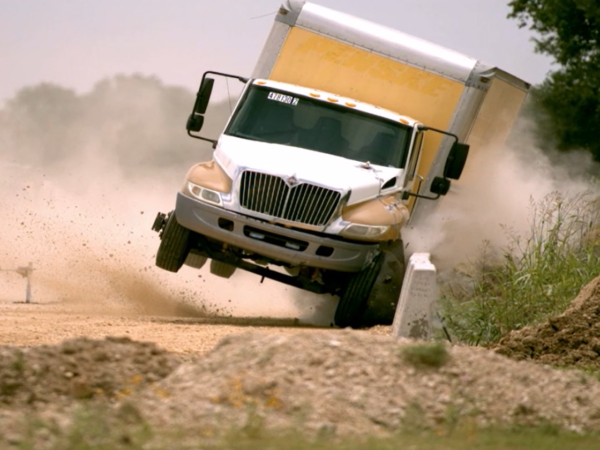
TL-4 Crash Test
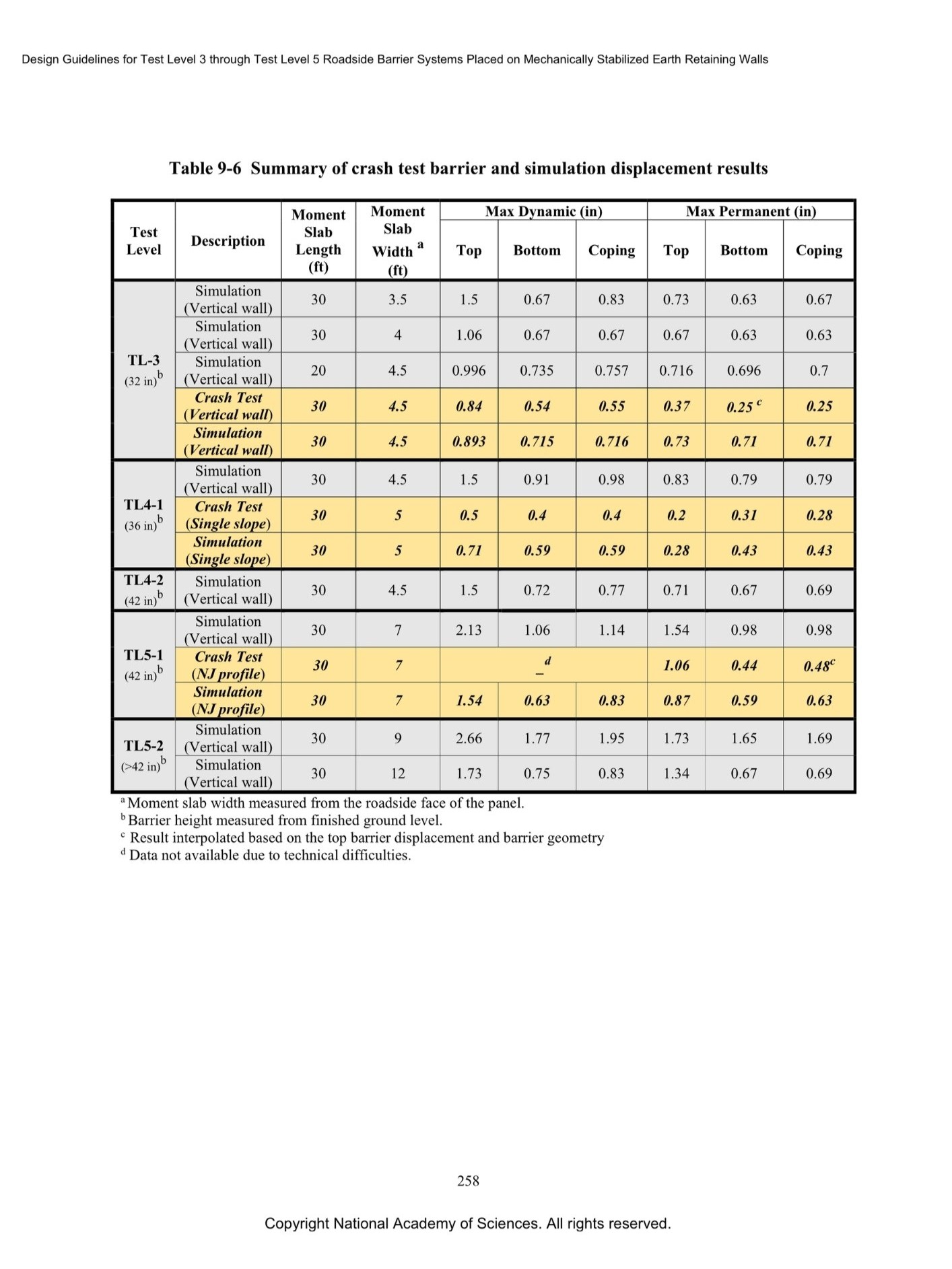
In all three cases, the performance of the barrier was excellent. The barriers successfully contained and redirected the vehicles meeting all MASH evaluation criteria, and the barrier displacements were acceptable such that the barriers can remain in service without barrier realignment or significant structural repair. Measured permanent displacements were 0.25 inch for TL-3, 0.3 inch for TL-4 and 0.5 inch for TL-5 at the roadway pavement elevation (coping elevation). Likewise, measured permanent displacements at the top of barrier were 0.37 inch and 0.20 inch respectively for TL-3 and TL-4 and 1.06 inch for TL-5.
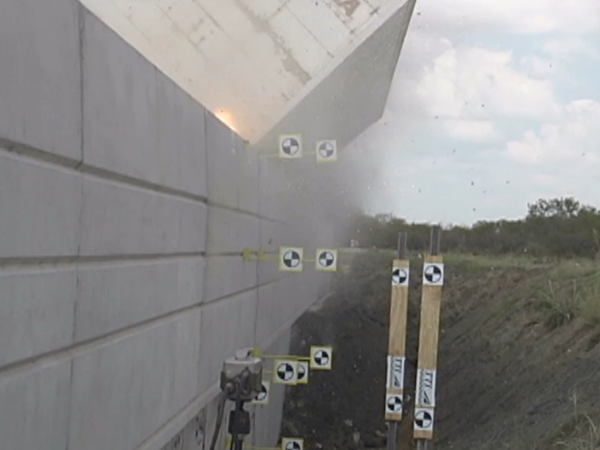
TL-5 Crash Test
LS-DYNA Simulations of Crash Tests
Numerous simulations of the impact events were analyzed by dynamic finite element modeling (LS-DYNA). Results of the full-scale crash tests were used to refine the models, with preliminary pre-crash test modeling greatly overestimating both the dynamic and permanent displacements of the crash tested barriers. After refinement of the models, the simulations were closer to actual behavior but continued to overestimate measured dynamic and permanent displacements for the crash tested barriers. See Figure 2 (Table 9-6 Summary of crash test and simulation displacements).
Recommended Precast Barrier and Moment Slab Dimensions
Recommendations for precast barrier length were determined based on practice and confirmed by full-scale crash tests and dynamic finite element modeling (LS-DYNA). A minimum precast barrier length of 10 ft is recommended for TL-3 and TL-4, and a minimum precast barrier length of 15 ft is recommended for TL-5. The minimum length of cast-in-place moment slab is 30 ft for all three test levels, joining two or three precast barrier sections together with each moment slab.
Recommendations for Moment slab width were determined based on the full-scale crash tests and simulations of dynamic displacement at the top of barrier. The following upper limits for dynamic displacement at top of barrier were considered reasonable in determining the moment slab width:
- TL-3: ≤ 1.0-inch
- TL-4: ≤ 1.5-inch
- TL-5: ≤ 1.75-inch
These values result in a maximum rotation angle of about 2 degrees during the event. It is also worth mentioning that these dynamic displacements exist for less than 1 second.
The full-scale crash tests and simulations confirmed the following moment slab widths are adequate to ensure acceptable performance of the barriers:
- TL-3: 4.5 ft.
- TL-4: 5.0 ft.
- TL-5: 7.0 ft.
Determination of dynamic displacement requires modeling, as full scale crash tests are expensive. It’s also worth mentioning that capturing dynamic displacement in actual crash tests is challenging for the instrumentation, especially for high impact loads such as TL-5 which result in impact energy and displacements which can damage instrumentation.
Traffic Barrier Performance
In addition to meeting MASH criteria, one of the best indicators of traffic barrier performance is the resulting permanent displacement of the barrier when subjected to a full-scale crash test and/or simulations by dynamic finite element modeling (LS-DYNA). Permanent displacement should be considered by highway agencies as an indicator of the barriers’ performance and whether the barrier can remain in service after an impact event. For this reason, NCHRP recommended a maximum permanent displacement of 1 inch at the roadway pavement elevation (coping elevation) from an impact. The crash tested precast barriers in this study performed as intended with permanent displacements for all three test levels, TL-3, TL-4, and TL-5, being less than one-half of the recommended maximum.
In practice, any barrier sections that are involved in a crash event should be inspected for parapet alignment with adjacent parapets and the impacted sections should be considered for any repairs needed to address structural and/or surficial damage.


