

Why Use Lightweight Backfill?
There are several solutions for accommodating poor foundation soil and expected settlement when designing MSE and modular retaining walls. Reinforced Earth® MSE and T-WALL® Precast Modular Retaining Walls have been constructed on hundreds of projects in conjunction with dozens of ground improvement techniques. This article will discuss the use of lightweight backfills in conjunction with Reinforced Earth and T-WALL.
Lightweight backfill is often recommended when poor foundation soils cannot support heavy loads, space constraints limit wall footprint, or constructability demands easier handling and faster installation. Typically, select granular backfill used in Geoquest solutions has a density of over 100 pcf. By reducing the weight of the wall volume, lightweight backfill minimizes the stress imposed on a relatively weak foundation.
In the past several decades, Geoquest has performed testing on several types of lightweight fill material and how they interact with our specific wall systems. Reinforced Earth and T-Wall retaining wall structures both have incorporated these lightweight fills on many projects over the past few decades. Each of these lightweight backfills have unique benefits depending on project requirements and constructability, but all effectively result in the same solution: a retaining wall design that exerts less pressure on the foundation than a typical structure.
Common Types of Lightweight Select Backfill for Geoquest Wall Systems
1. Lightweight Aggregates
Lightweight aggregates are natural or processed, and have a density range of around 45 to 50 pounds per cubic foot. Shale, clay and slate can be processed by heating in a rotary kiln at high temperatures, causing it to expand to a durable lighter weight product. Pumice is another lightweight aggregate, which is a naturally occurring porous volcanic rock.
The materials have been tested for durability and are available in various markets in the USA. With typical gradation from coarse sand to ¾-inch crushed stone, it has a high internal angle of friction and is suitable for most retaining wall applications.
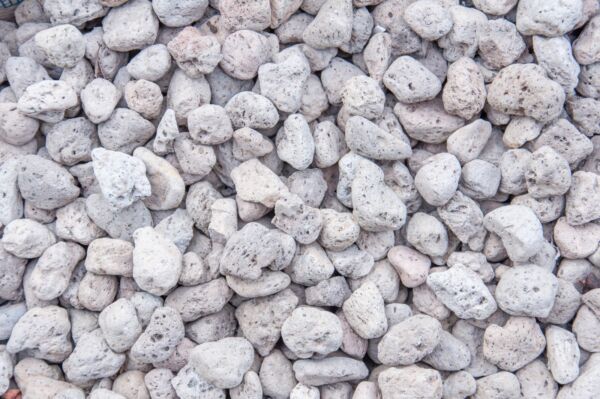
Pumice Aggregate
2. Ultra-Lightweight Foamed Glass Aggregates (FGA)
Foamed glass aggregate is manufactured from recycled container glass. The material is kiln-heated with a foaming agent and extruded onto cooling conveyor. It’s fractured into individual particles during cooling.
The material is ultra-light, at around 15 to 20 pounds per cubic foot, and functions as a typical select granular backfill.
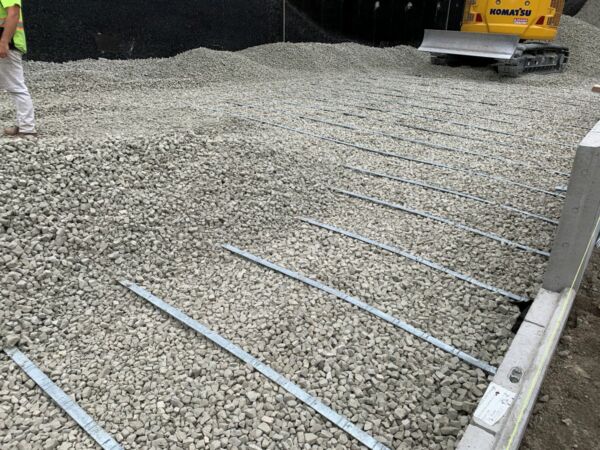
FGA, Terminal B Logan Airport, Boston, MA (Aero Aggregates)
3. Low-Density Cellular Concrete (LDCC)
Low-density cellular concrete (LDCC) is a lightweight backfill that is flowable during installation. It incorporates a high volume of air voids created by introducing a foaming agent into a cement slurry.
The density is typically around 30–40 pounds per cubic foot for Geoquest retaining wall applications. LDCC for MSE applications is modeled as a stiff soil. While cementitious in content, the material has a relatively low compressive strength on the order of 50 to 200 psi.
LDCC has been used for Reinforced Earth MSE walls for over 30 years. The backfill is flowable, easy to place, and ideal for cases where the foundation, geometry, and construction constraints are not typical.
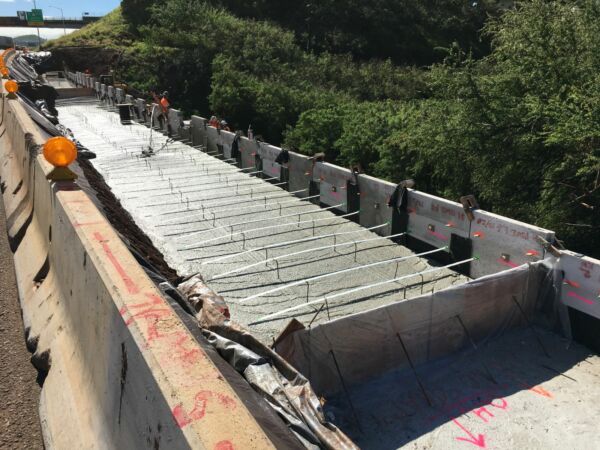
LDCC, H-1 Shoulder Widening, Honolulu, HI
4. EPS Geofoam Blocks
EPS geofoam blocks are an ultralightweight backfill solution when other ground improvement techniques are not feasible. While generally not compatible with MSE structures, EPS Geofoam is feasible with the T-Wall retaining wall system. The material is extremely light weight expanded polystyrene that is delivered in blocks and easy to handle. The blocks can be quickly cut if needed for tight spaces and installed to accommodate the T-Wall stems. Unique design constraints include the use of a load distribution/protection slab atop EPS fill, which is not required for other lightweight fill materials.
Design Considerations
As with retaining walls using conventional backfill, when incorporating lightweight backfill geotechnical analysis is essential to confirm global stability and foundation capacity. Pullout and tensile capacity of reinforcements must be verified for compatibility. Drainage and durability should be addressed to maintain long-term performance.
Performance of lightweight aggregates, foamed glass aggregate and LDCC have been proven through pullout testing with Geoquest’s high adherence steel reinforcing strips. Pullout testing of our Geostrap® polymeric reinforcements has also been completed with FGA.
The following is a basic summary of design considerations:
- Reinforced Earth or T-Wall structure design:
- External stability
- Internal stability
- Address the characteristics of the lightweight select backfill:
- Material properties
- Construction loading
- Buoyancy and saturation
- Seismic
- For soil reinforcements and T-Wall stems:
- Frictional compatibility with the backfill (shear strength and gradation)
- For steel soil reinforcements:
- Backfill shall meet pH, resistivity, chloride and sulfate limits
- For geosynthetic soil reinforcements:
- Backfill shall meet pH limits
- Installation damage testing required for aggregate fills
Conclusion
Lightweight backfill offers practical solutions for challenging site conditions, reducing loads and improving stability without compromising performance. Whether using LDCC, lightweight aggregates, foamed glass, or EPS geofoam, these materials expand the versatility of Geoquest’s Reinforced Earth® and T-Wall® systems.
Key Considerations:
Lightweight Fills
- Reduce bearing pressure, settlement, and lateral earth pressure
- Must meet mechanical and electrochemical requirements
Manufactured Aggregates
- Use traditional wall design methods
- Construction procedures are similar to conventional wall structures
LDCC
- For Reinforced Earth MSE design, treat LDCC as stiff soil
- Fluid during placement to be considered in design and construction means and methods
- Avoid soil reinforcements at cold joints


